Most manufacturer recommendations say "every 3–6 months." That is not a maintenance schedule — it is a guess. Your correct descaling interval depends on three variables: your water hardness, your machine type, and how often you brew. This calculator uses those inputs to give you a specific number.
| Hardness Level | GPG Range | ppm Range | Common Regions |
|---|---|---|---|
| Soft | 0–3.5 GPG | 0–60 ppm | Pacific Northwest, New England coast |
| Moderate | 3.5–7 GPG | 60–120 ppm | Midwest, Mid-Atlantic |
| Hard | 7–10.5 GPG | 120–180 ppm | Southwest, Great Plains, Florida |
| Very Hard | 10.5+ GPG | 180+ ppm | Phoenix AZ, Las Vegas NV, Dallas TX |
Machine type matters because boiler volume and operating temperature vary significantly. A moka pot's aluminum boiler is in direct contact with coffee-temperature water continuously — scale accumulates faster and damages aluminum more aggressively than stainless steel. An espresso machine heats a larger water volume to a higher temperature per cycle. A drip machine cycles a large volume through a low-temperature element — slower scale accumulation per unit volume.
Brew frequency matters because scale deposits are proportional to the volume of water heated. A household brewing 6 cups per day will scale their machine at three times the rate of a household brewing 2 cups per day, regardless of water hardness.
The formula combines a base interval (by machine type) with multipliers for both hardness and frequency. The result is the number of days between descaling cycles — not an approximation, but a calculated estimate based on your specific inputs.
| Water Hardness | Citric Acid Concentration | Notes |
|---|---|---|
| Soft (0–3.5 GPG) | 1.5g per 100ml water | Standard concentration sufficient |
| Moderate (3.5–7 GPG) | 2g per 100ml water | Manufacturer-equivalent concentration |
| Hard (7–10.5 GPG) | 2.5g per 100ml water | Increase concentration for heavier deposits |
| Very Hard (10.5+ GPG) | 3g per 100ml water | Consider inline water filter to reduce hardness |
For model-specific descaling procedures, see your brand's maintenance guide: Keurig Master Maintenance Guide · Breville Master Maintenance Guide.
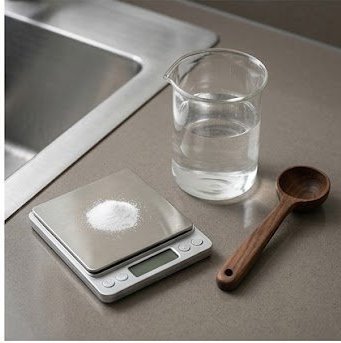
At 2g per 100ml, a 2lb bag contains enough citric acid for approximately 450 descaling cycles — enough for 10+ years of quarterly descaling on a single machine, or to supply several machines simultaneously. Food-grade citric acid is functionally identical to branded descaling solutions at a fraction of the cost. This is what we use and what we recommend.
View on Amazon →As an Amazon Associate, CoffeeFixManual earns from qualifying purchases.
I don't know my water hardness. What should I assume?
The US average tap water hardness is approximately 7.5 GPG (moderate-to-hard). If you are in a city with a known hard water supply (Phoenix, Las Vegas, San Antonio, Indianapolis) assume 12–15 GPG until you test. If you use a Brita or similar carbon filter, it does not reduce hardness — assume your tap water reading applies. A reverse-osmosis system reduces hardness significantly, typically to under 1 GPG.
Does using bottled water eliminate the need to descale?
No. Most bottled spring water contains 50–150 ppm dissolved minerals (roughly 3–9 GPG equivalent). Some brands are harder than tap water in soft-water cities. Descaling is still required — the interval may be longer depending on the specific brand's mineral content. Check the bottled water label for "total dissolved solids" (TDS) or "hardness as CaCO₃" — divide the latter by 17.1 to convert to GPG.
Calculator results are estimates based on typical scale accumulation rates. Actual intervals may vary. When in doubt, descale more frequently — over-descaling causes no harm to machine components when citric acid is used at the concentrations specified.